Frame4SDR
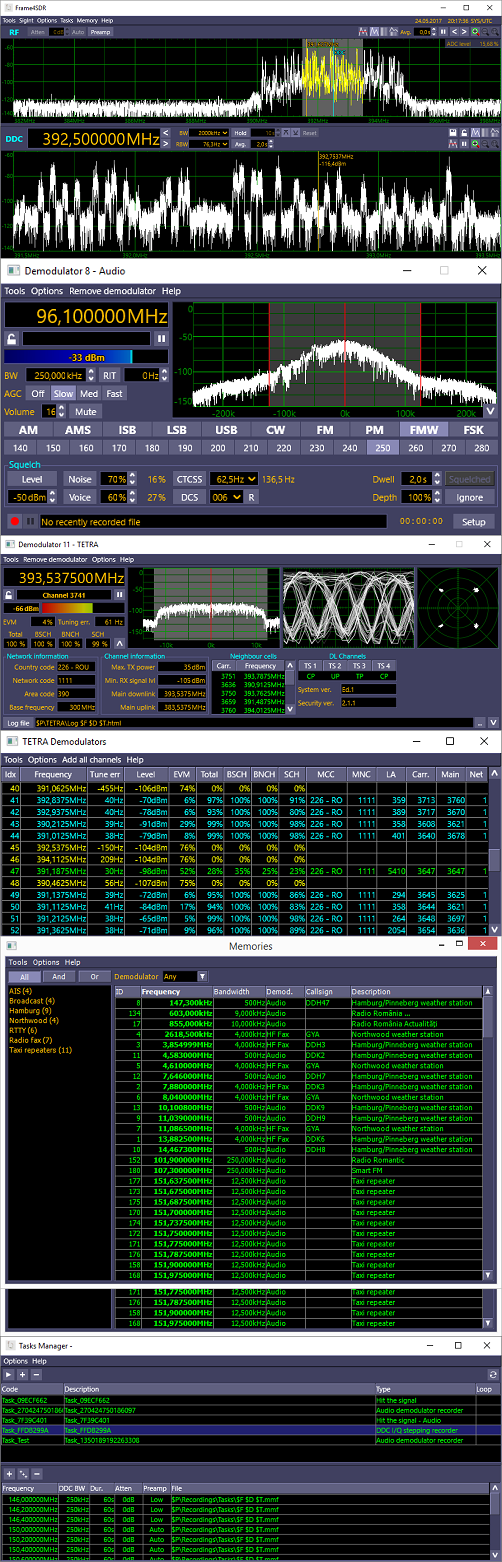
Software defined receivers bring great flexibility to users, in principle allowing bespoke functionality to be easily provided. This in itself brings potential problems, as often the user interface can become cumbersome and overly complex for the day to day user, as more and more perhaps unwanted functionality is added to the core.
Frame4SDR is constructed in such as way as the core package may be configured to minimise complexity. In addition, new functionality can be quickly and cost effectively developed and a new version supplied.
Frame4SDR is a flexible virtual panel for wide band radio receivers. It features a very intuitive user interface that allows defining any number of demodulators, decoders and demodulator-like functions, as long as the associated PC is equipped with sufficient processing power and memory available.
Supported radio receivers
Frame4SDR currently supports the following SDR receivers:
- Microtelecom Perseus - 64-bit Windows/Linux on x86 processors, 32-bit/64-bit Linux on ARM processors
- SDRPlay RSP1A/RSP1B - 64-bit Windows/Linux on x86 processors, 32-bit/64-bit Linux on ARM processors
- SignalHound BB60* series (BB60A, BB60C, BB60D) - 64-bit Windows/Linux on x86 processors
- SignalHound SA44*/SA124* series (SA44, SA44B, SA124A, SA124B) - 64-bit Windows/Linux on x86 processors, deprecated driver on Linux
- SignalHound SM200* series (SM200A, SM200B, SM200C) - 64-bit Windows/Linux on x86 processors
- WiNRADiO G31DDC/G33DDC - with 32-bit application on 64-bit Windows
- WiNRADiO G35DDC - 64-bit Windows/Linux on x86 processors
- WiNRADiO G39DDCi/e - 64-bit Windows on x86 processors
- WiNRADiO G65DDCe over USB3 - 64-bit Windows on x86 processors
Frame4SDR can be used for implementing direction finding solutions with the following receivers:
- SignalHound BB60C receivers
- SignalHound SM200* series receivers
Available demodulators
The list of available demodulators is continuously increasing, depending on the user requirement, software license and radio receiver capabilities (i.e. for some demodulators the maximum DDC bandwidth may not be large enough). The list includes:
- Audio demodulator - demodulator for analogue transmissions, such as FM/SSB/CW/AM.
- Generic FSK, GMSK and π/4 DQPSK demodulators with bits/symbols logging and pattern detection.
- VHF ACARS and ADS-B decoders for aircraft broadcasted information.
- AIS decoder for ships broadcasted information.
- DMR, D-STAR decoders for digital mobile radios (with audio codec implemented through licensed USB devices).
- TETRA decoder - decoder for the unencrypted technical data in the downlinks of TETRA networks. By combining several TETRA decoders, on different channels, the structure of the monitored networks can be determined and more advanced problems can be determined (beyond the easily detectable transmitter/modulation issues).
- IQ recorder - narrow band IQ recorder that provides supplementary decimation. By using it, several narrow band transmissions can be recorded simultaneously from a wide band DDC stream.
Other features
The application provides a memories management engine based on SQLite, with any number of user defined groups and any number of memories associated to none, one or more of the groups. Filtering is provided based on the associated demodulators and the groups.
A tasks management engine is also provided, again based on SQLite for settings storage, with different jobs to be performed based on the type of the task, for example:
- Audio demodulator recorder - Scheduler for recording the demodulated audio of specific transmissions.
- DDC I/Q stepping recorder - Tunes the receiver to a frequency, sets the DDC bandwidth and records the IQ stream for the specified amount of time. The task may contain any number of such jobs to be executed only once or in a continuous loop.
- Hit the signal - Tunes the receiver to a frequency, sets the DDC bandwidth and creates an IQ recorder or audio demodulator for each detected transmission, with the specified parameters.
All produced recordings are using either the WAV file format or the bespoke MMF file format (fully documented in the associated help file). The recorder associated to the DDC produces MMF files in order to allow dynamically changing the tuned frequency and the DDC bandwidth and embedded time/position markers. The narrow band I/Q recorder allows choosing the file format, with user configurable parameters for WAV files so they can be further used in other applications. Audio recordings are always WAV files.
All internal databases are completely documented in the help file so the data within can be further used by other applications or can be extracted from other sources.
Extra features:
- Clean user interface, no unnecessary features.
- Client/server design - locate your receiver anywhere in the world where's an internet connection, network bandwidth for acceptable reception can be as low as 45 kbps.
- Low CPU usage, achieved by many years of experience.
- Licensed and configured to user needs - to simplify the user interface and protect the codebase.
- Multi-monitor support.
For more information don't hesitate to contact us!